
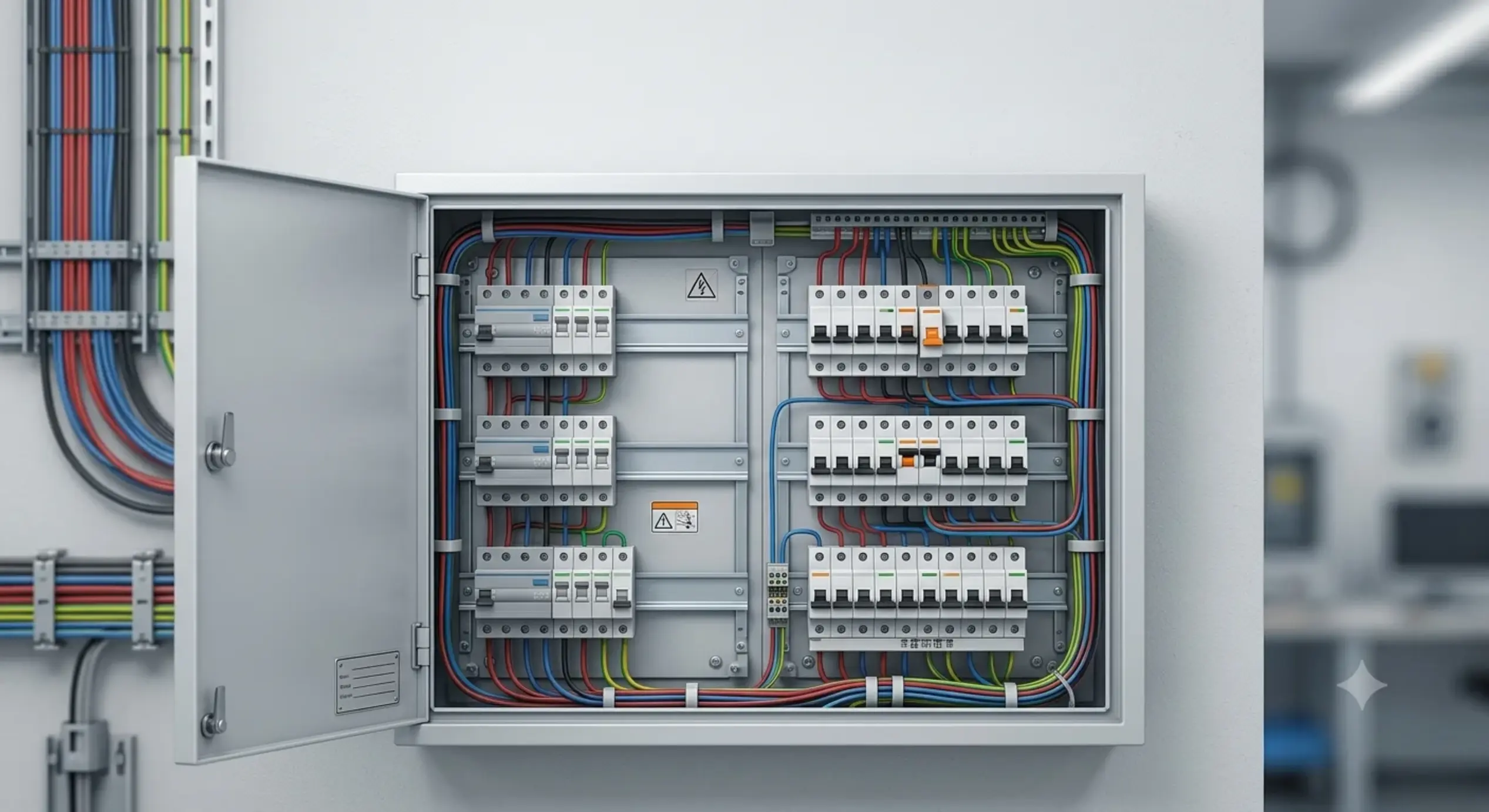
What Is a Circuit Breaker? How It Works, Types, and Why It Matters
Target keyword: circuit breaker | Supporting keywords: what is a circuit breaker, explain it, how does a circuit breaker work, circuit breaker breaker, circuit breaker replacement | Word count target: ~1500
The power goes out in one room, but not the rest of the house. You walk to the electrical panel, find one switch sitting slightly out of line with the others, flip it back, and the lights come on again. That switch is a circuit breaker, and understanding exactly what it does, and why it tripped in the first place, can save you a call-out fee and a lot of guesswork the next time it happens.
In simple terms, a circuit breaker is an automatic electrical switch designed to protect a circuit from damage caused by excess current, whether from an overload or a short circuit. When current exceeds a safe limit, the breaker trips and stops the flow of electricity before wires overheat, insulation melts, or a fire starts.
What Is a Circuit Breaker, Exactly?
A circuit breaker is an electromechanical safety device installed in electrical distribution panels. Its job is to monitor the current flowing through a circuit and automatically interrupt that current the moment it climbs above a safe, pre-set threshold. Unlike a fuse, which sacrifices itself and needs replacing, a circuit breaker can simply be reset and switched back on once the underlying problem is fixed.
Every circuit in a home, office, or factory is rated to carry a certain amount of current safely. The moment that rating is exceeded, whether because too many appliances are running at once or because a fault is pulling extra current, the wiring is at risk of overheating. A circuit breaker exists purely to catch that moment and shut things down before damage occurs.
A Quick Look at a Typical Electric Circuit
Any basic electric circuit follows the same pattern: current leaves the power source, travels through conductive wiring to whatever device needs power, whether that’s a motor, a heater, or a light fixture, and then returns to the source. A circuit breaker sits directly in that path so it can interrupt the current the instant something goes wrong, before the fault reaches the rest of the circuit.
How Does a Circuit Breaker Work?
A standard thermal-magnetic circuit breaker relies on two separate protection mechanisms working side by side.
Thermal Protection
Inside the breaker sits a bimetallic strip, made of two different metals bonded together. As current flows through it, the strip heats up. If the current stays within a safe range, nothing happens. But if the circuit is overloaded for a sustained period, the strip heats enough to bend, which physically pushes the switching mechanism and breaks the connection, stopping the current.
Magnetic (Short-Circuit) Protection
Running in parallel is a small electromagnet, usually a copper coil, that reacts to sudden, large surges in current, the kind you get from a short circuit rather than a slow overload. When the current spike is big enough, the resulting magnetic force is strong enough to pull a small internal part and trip the breaker almost instantly, well before heat would have built up through the thermal strip alone.
Together, these two mechanisms mean a single breaker can protect against both a slow, sustained overload and a sudden, dangerous short circuit, using two different physical processes.
A Short History: From Fuses to Modern Circuit Breakers
Long before it existed, the fuse was the standard way to protect a circuit. Early fuse concepts are linked to Thomas Edison’s work on protecting the lighting networks he was installing in major cities in the late 1800s. A fuse contains a metal strip that heats up and melts once current gets too high, physically breaking the circuit. The catch is that once a fuse blows, it’s finished. It has to be physically replaced before power can be restored, which is inconvenient and, in an industrial setting, expensive.
The modern circuit breaker solved that problem decades later. In the early 1920s, engineer Hugo Stotz developed a compact device in Germany that combined thermal and magnetic protection into a single unit that could be switched back on after tripping, rather than discarded. That single innovation, a resettable protective switch, is essentially the circuit breaker design still used across homes and industry today, refined but fundamentally unchanged.
The Basic Parts of a Circuit Breaker
- A terminal on each end to connect the incoming and outgoing wiring
- A stationary contact and a moving contact that touch when the breaker is switched on
- A bimetallic strip for thermal (overload) protection
- An electromagnet coil for magnetic (short-circuit) protection
- A catch and switching mechanism that physically separates the contacts when tripped
Common Types of Circuit Breakers
Circuit breakers aren’t one-size-fits-all. Depending on the application, you’ll come across:
- MCB (Miniature it) — the standard breaker in most home distribution boards, typically rated up to 100 amps.
- MCCB (Moulded Case it) — used for higher current ratings, common in commercial and light industrial settings.
- RCCB / GFCI it — trips based on current leakage rather than overload, protecting against electric shock rather than just fire risk.
- ACB (Air it) — used in low-voltage industrial systems and main power distribution boards.
- Single-pole, double-pole, and three/four-pole breakers — describing how many live wires (or phases) a single breaker switches at once.
Circuit Breaker vs Fuse: What’s the Difference?
The core difference comes down to reusability. A fuse sacrifices a metal element to break the circuit and must be replaced every time it does its job. A circuit breaker uses a mechanical switching action instead, so once the fault causing the trip is resolved, you simply reset the breaker and the circuit is protected again. That’s why almost every modern home and facility uses it instead of fuse boxes today, even though fuses are still used in some specific low-cost or high-precision applications.
Why a Circuit Breaker Keeps Tripping (And What To Do About It)
- Overloaded circuit: too many high-draw appliances running on the same circuit at once.
- Short circuit: a live wire touching a neutral or ground wire, causing a sudden current spike.
- Ground fault: current leaking to earth through a faulty appliance or damaged wiring.
- A worn-out or faulty breaker: after enough trip cycles, breakers can wear out and trip too easily, or fail to trip when they should.
If a breaker trips once, resetting it is usually fine. If it trips repeatedly, that’s a signal to unplug devices on that circuit and, if the problem continues, call a licensed electrician rather than continuing to reset it.
Why Circuit Breakers Matter
Circuit breakers are one of the simplest devices in your home, yet they quietly prevent one of the most common causes of electrical fires: overheated wiring from sustained overloads or short circuits. They also protect the appliances and equipment connected to the circuit from damage caused by unstable current. In industrial settings, correctly sized and maintained it are a core part of any electrical safety plan, protecting both equipment and the people working around it.
The Bottom Line
A circuit breaker is a small device with one job: stop dangerous levels of current before they cause damage. Understanding how it detects overloads and short circuits, and knowing the difference between a one-off trip and a recurring problem, means you can reset it with confidence when it’s safe to do so, and know exactly when it’s time to call in a professional instead.
Frequently Asked Questions
What is a circuit breaker in simple terms? It’s an automatic switch that cuts off electrical current when it detects an overload or short circuit, protecting wiring and equipment from damage.
How does a circuit breaker work? It uses a heat-sensitive bimetallic strip for overloads and an electromagnet for short circuits, either of which can physically trip the switch and stop current flow.
What is the difference between a circuit breaker and a fuse? A fuse must be replaced after it blows, while a circuit breaker can be reset and reused once the fault is cleared.
What are the common types of it? MCBs for standard home use, MCCBs for higher loads, RCCBs/GFCIs for shock protection, and ACBs for industrial main distribution.
Why does my circuit breaker keep tripping? Usually an overloaded circuit, a short circuit, a ground fault, or a worn-out breaker. Repeated tripping should be checked by an electrician.